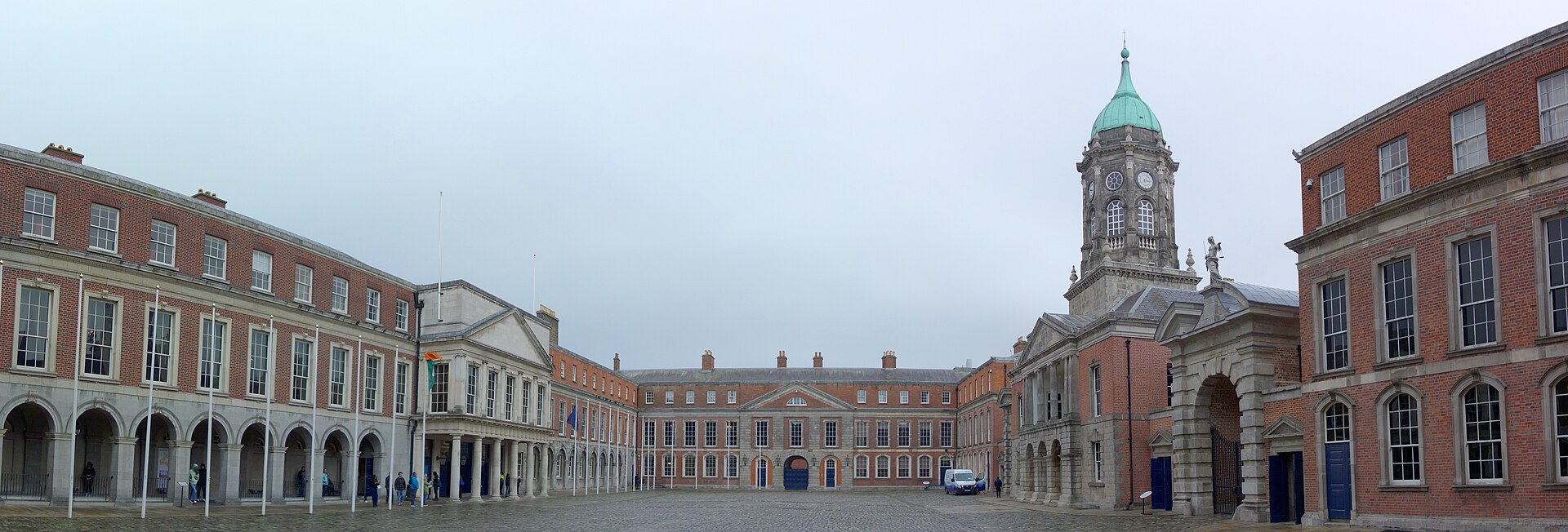

The first thing visitors say when they see Dublin Castle is: “That’s not a castle.”
They’re half right.
From Dame Street, most of it looks like a very grand government office, because that’s what it was for 700 years. The castle was started in the early 1200s on the site of a Viking settlement, and it was the headquarters of English and then British rule in Ireland until it was handed over to the new Irish government in 1922.
There’s one proper round medieval tower left, and some of the old walls underground. The rest is Georgian splendour, and it’s well worth an hour.
Closed to visitors until January 2027
Dublin Castle is closed to the public until January 2027. The castle is the main venue for Ireland’s Presidency of the Council of the European Union, so the State Apartments closed on 5 May 2026 and the whole castle site, including the courtyards, the Dubh Linn Garden and the Chester Beatty, closed on 15 June. There’s no walk-through from Dame Street to Ship Street while it’s shut.
If you’re visiting before then, you can still see the outside from Dame Street and Castle Street, and these are all within a few minutes’ walk:
- Dublinia and Christ Church Cathedral for Viking and medieval Dublin
- Trinity College and the Book of Kells
- The free National Museum of Ireland – Archaeology on Kildare Street
Check the official Dublin Castle website for the reopening date. The rest of this guide covers what you’ll see once it’s open again.
Guided or self-guided? It matters
This is the decision that catches people out.
- Self-guided lets you walk the State Apartments at your own pace, plus any exhibitions on site. About 30 minutes.
- Guided takes about an hour and adds the two best bits: the Viking and medieval excavation under the castle, where you can see the base of the old walls and the moat, and the Chapel Royal, a Gothic Revival chapel that looks like it was carved out of a wedding cake. These can only be seen on a guided tour.
Pay the extra few euro for the guided tour. It’s the difference between seeing some nice rooms and understanding why the place matters.
Ticket prices
Official prices before the closure, checked November 2026. They may change when the castle reopens:
Self-guided
- Adult €8, Senior (60+) €6, Student (18+) €6, Child (12–17) €4, under-12s free
- Family (2 adults and 3 children): €20
Guided tour
- Adult €12, Senior (60+) €10, Student (18+) €10, Child (12–17) €6, under-12s free
- Family (2 adults and 3 children): €30
Normally, tickets can be booked online up to 15 days ahead, and a limited number are sold on the day at the ticket desk in the State Apartments. No tickets are on sale while the castle is closed.
Check tickets and times on the official Dublin Castle site
Opening hours
Closed until January 2027. When open, it runs every day including bank holidays, 9:45am to 5:45pm, last admission 5:15pm, and closes 25–27 December and 1 January.
Remember it’s a working government complex. The State Apartments are where Irish presidents are inaugurated and where state dinners are held, so rooms can close at short notice. Check before you go if you’re coming on a tight schedule.
What you see
The State Apartments
Built for the Viceroy, the man who ran Ireland on behalf of the Crown. Silk walls, chandeliers, enormous portraits of men who look like they’ve just been told the Irish have opinions. St Patrick’s Hall, with its painted ceiling, is the showstopper. The Throne Room has, as you’d hope, a throne.
The excavation (guided tour only)
Down below, you can see where the River Poddle once ran past the walls into the dark pool, the dubh linn, that gave Dublin its name. It’s the best part of the castle and almost nobody expects it.
The Chapel Royal (guided tour only)
Every surface is decorated: carved oak, stone heads of saints and monarchs, stained glass. The coats of arms of every Viceroy are on the walls and windows. They ran out of space eventually, which some people would call a metaphor.
The free things right beside it
Here’s where Dublin Castle gets really good value once it reopens. Within the castle grounds and a few steps away you’ll find:
- The Chester Beatty, in the castle gardens. A collection of manuscripts, prints and decorative objects from across Asia, the Middle East and Europe, gathered by an American mining millionaire who settled in Dublin. Free entry, and one of the finest small museums in Europe. That’s not exaggeration. It’s closed along with the castle until January 2027, so check its website before you plan around it.
- The Dubh Linn Gardens behind the castle. A neat circle of lawn with the snake-like path patterns, and a quiet place to sit.
- City Hall, right at the castle gate on Dame Street, with its beautiful domed rotunda.
Accessibility
The State Apartments, the Terrace Café and the Castle Gardens are fully wheelchair accessible, with accessible toilets in the State Apartments. Buggies can’t go into the State Apartments, but staff will store them for you.
Getting there
Dublin Castle is on Dame Street, Dublin 2, about five minutes’ walk from Trinity College and Temple Bar. Any bus into the centre gets you within a short walk.
Once it reopens, it sits on the walk from Trinity to Dublinia and Christ Church Cathedral, so you can do all three in one morning and finish at the Guinness Storehouse.
Dublin Castle FAQs
Is Dublin Castle open?
No. The whole castle site, including the courtyards, gardens and the Chester Beatty, is closed to the public until January 2027 for Ireland’s EU Presidency.
Is Dublin Castle free?
When it’s open, the courtyards, gardens and the Chester Beatty are free. The State Apartments need a ticket, from €8 self-guided or €12 guided (prices before the closure).
Can I see the Chapel Royal without a guided tour?
No. The Chapel Royal and the Viking excavation are only included on the guided tour.
How long does Dublin Castle take?
About an hour on the guided tour, or around 30 minutes self-guided. Add an hour for the Chester Beatty once it reopens.
Does the Go City Dublin Pass cover it?
The castle is listed on the Go City Dublin Pass, but you can’t use it while the castle is closed. Before the closure, pass holders got a self-guided visit and paid a €3 upgrade for the guided tour.
Prices and hours checked on the official Dublin Castle website, November 2026.
More in our guide to things to do in Dublin.