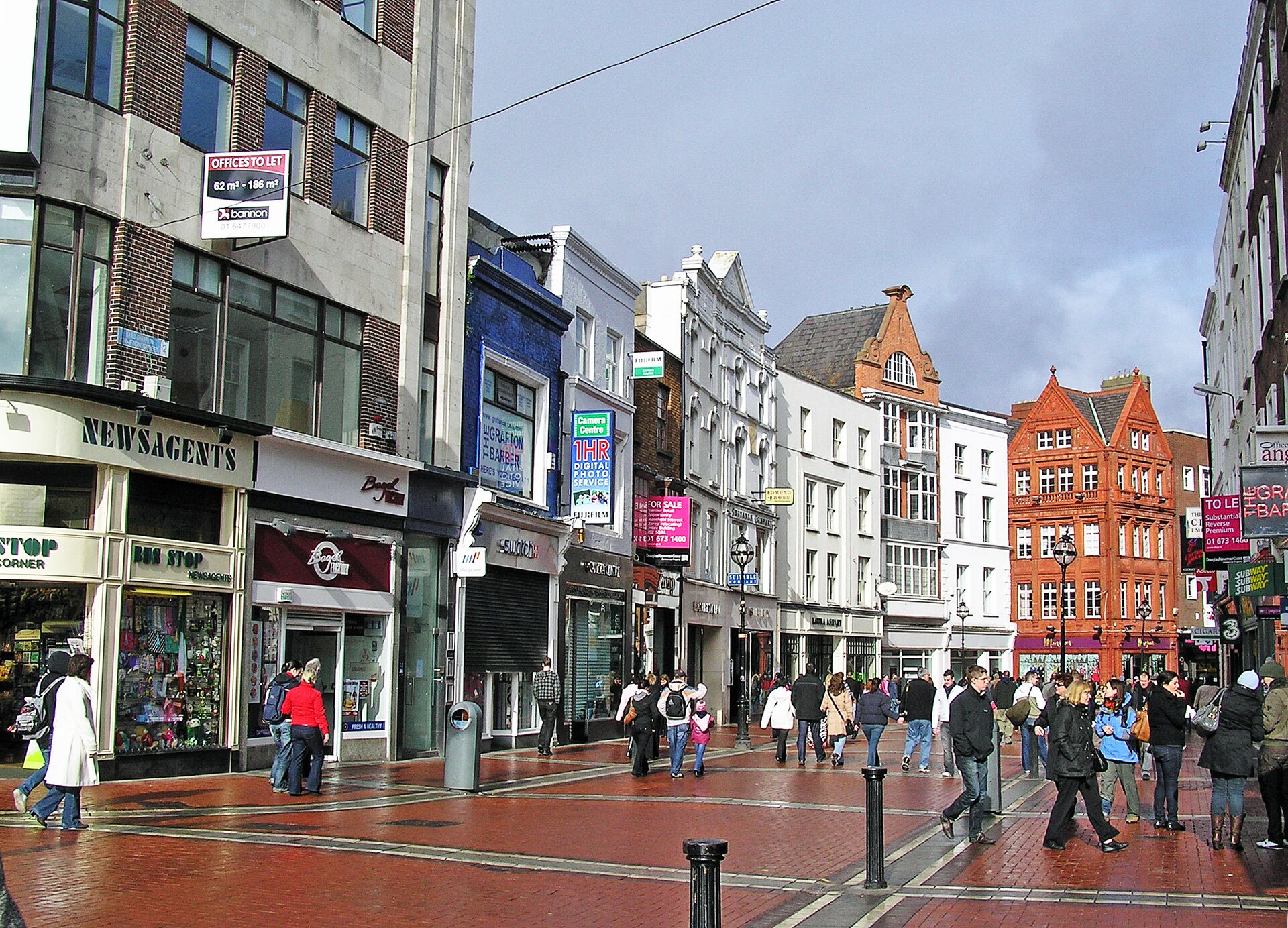

Dublin has two main shopping streets, and which one you prefer says a lot about you.
Grafton Street, on the southside, is the posh one, with buskers. Henry Street, on the northside, is the busy one, with bargains. Dubliners will defend either one, depending on which side of the river they grew up.
Grafton Street
The pedestrian street running from Trinity College up to St Stephen’s Green. Department stores, Irish and international brands, and Dublin’s best buskers, some of whom have gone on to be quite famous. Stand at the top near the Green on a Saturday afternoon and you’ll hear three different songs at once.
Look out for Bewley’s on Grafton Street, the city’s most famous café, with stained-glass windows by Harry Clarke. And just round the corner from the bottom of the street, on Suffolk Street, is the statue of Molly Malone, which everyone photographs and nobody can explain. We’ve written about her in Dublin’s statues.
Powerscourt Townhouse Centre
Just off Grafton Street on South William Street: an 18th-century Georgian townhouse built for Viscount Powerscourt, now a shopping centre with independent shops, Irish design, antiques and cafés in a glass-roofed courtyard. One of the nicest places in the city to spend an hour when it’s raining.
George’s Street Arcade
A Victorian covered market on South Great George’s Street, with red-brick Gothic arches outside and stalls inside: vintage clothes, records, books, jewellery and street food. It’s been trading since the 1880s, and it’s one of the best places in Dublin. The streets around it, Drury Street, South William Street and Wicklow Street, are full of independent shops.
Henry Street and Mary Street
Off O’Connell Street on the northside: department stores, high-street chains, and two big shopping centres, the Jervis Centre and the Ilac. Busy, practical, cheaper.
Moore Street
Just off Henry Street, the old open-air fruit and vegetable market, where traders have been shouting their prices for generations. These days it’s also full of international grocers. It’s where the 1916 rebels finally surrendered, a story told at the GPO Museum round the corner.
Temple Bar
On Saturdays there’s a food market in Meeting House Square. Otherwise Temple Bar is more about pubs and souvenirs than shopping. Our guide to what Temple Bar actually is explains the rest.
What to bring home
Skip the plastic leprechauns. Better Irish souvenirs:
- Irish knitwear (Aran jumpers), from proper knitwear shops rather than souvenir stalls. Check the label says made in Ireland.
- Irish whiskey, especially something you can’t easily buy at home. The distillery shops have bottles only sold there.
- Books by Irish writers. Dublin is a UNESCO City of Literature and has excellent independent bookshops.
- Irish design: pottery, linen, jewellery and prints, from places like Powerscourt Townhouse and the shops around George’s Street.
- Food: Irish butter, cheese, smoked salmon, tea and brown bread mix. Check your own country’s customs rules for food before you pack it.
Practical tips
- Shops generally open around 9 or 10am and close about 6 or 7pm, with late opening on Thursdays in the city centre, and shorter hours on Sundays.
- Tax-free shopping: visitors from outside the EU can often claim back VAT on purchases. Ask in the shop for the tax-free form.
- Cards are accepted almost everywhere, including market stalls and buskers’ card readers, which is a development nobody saw coming.
Where to stay near the shops
If shopping’s a big part of your trip, stay on the southside near Grafton Street or around St Stephen’s Green. See our guide to where to stay in Dublin.
More in our guide to things to do in Dublin.