
If you want to understand the shape of Dublin, walk the river.
The Liffey cuts the city in two, northside and southside, and Dubliners have opinions about which side you’re from long before they’ve learned your name. The quays along both banks have the city’s grandest buildings, its best bridges, and, further east, the glass and steel of the new Docklands.
Here’s the walk, west to east, about 3km and an hour and a half at a stroll, longer if you stop.
1. The Four Courts
Start on Inns Quay at James Gandon’s great domed courthouse, built between 1786 and 1802. It was the scene of the opening shots of the Civil War in 1922, when Free State forces shelled anti-Treaty rebels inside, and the Public Record Office beside it, with centuries of Irish records, was blown up. It was rebuilt, and it’s still Ireland’s main courts building, so you’ll see barristers in wigs hurrying along the quay.
From here, it’s a short walk up to Smithfield and the Jameson Distillery, and just across the river to Dublinia and Christ Church.
2. The bridges
Walking east, you’ll pass some of the city’s best-loved bridges:
- The James Joyce Bridge and Rory O’More Bridge are further west, by Usher’s Island, if you want to start there instead.
- The Millennium Bridge, a simple footbridge into Temple Bar.
- The Ha’penny Bridge, the white cast-iron arch from 1816 that’s on every postcard. It got its name from the halfpenny toll once charged to cross it.
- O’Connell Bridge, the only bridge in Europe, so they say, that’s wider than it is long.
There’s a whole post about the bridges of Dublin.
3. The Custom House
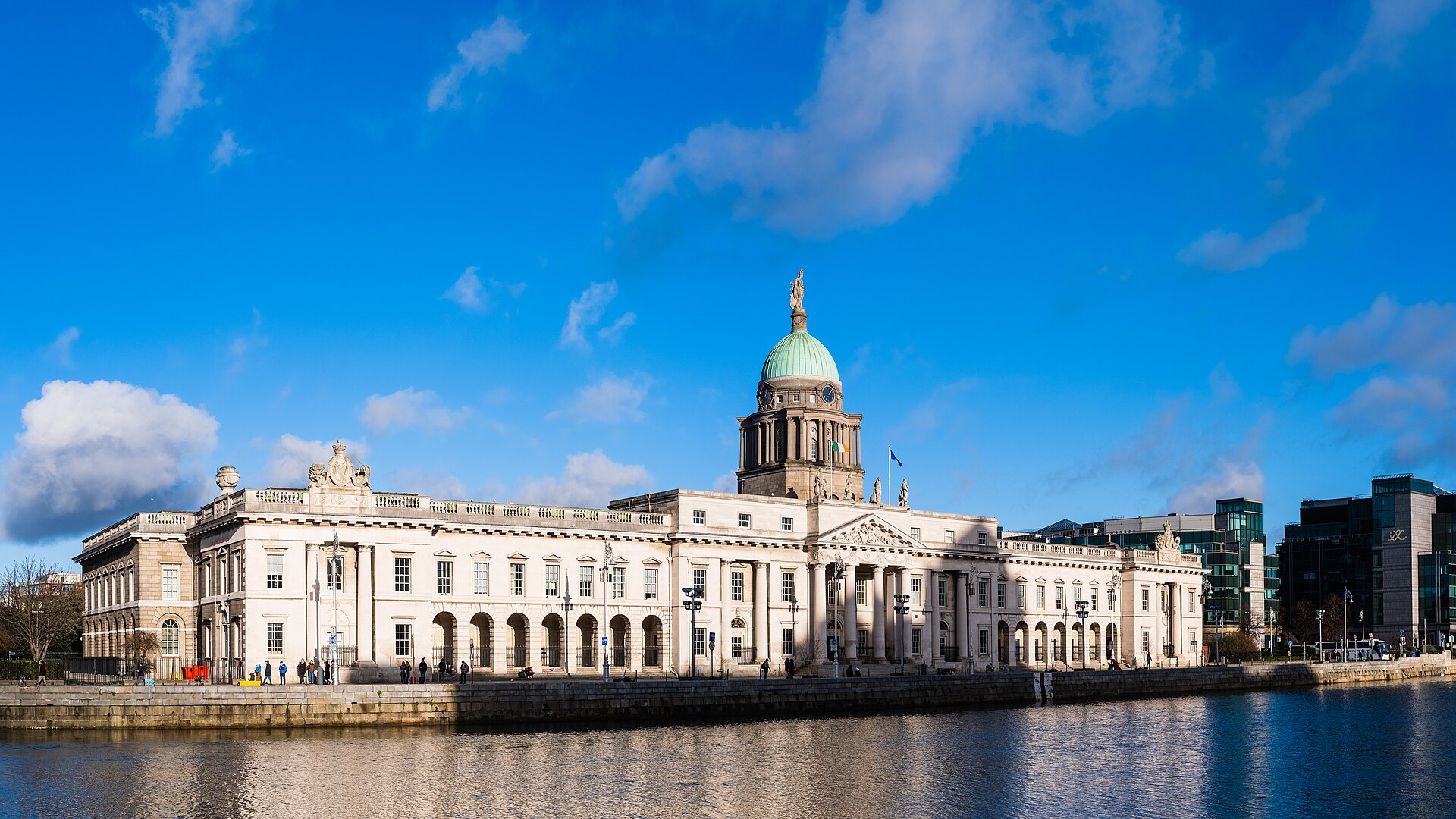
Past Butt Bridge, the long white front of the Custom House fills the north quay. Another Gandon masterpiece, finished in 1791, burned by the IRA in 1921 during the War of Independence, and restored. It’s the longest-serving purpose-built government building in Ireland.
The Custom House Visitor Centre tells the story of the building, the burning and the restoration. Open daily 9:30am–5:30pm (last admission 4:45pm).
- Self-guided: €6 adult, €5 senior, €3 child/student, €15 family
- Guided: €8 adult, €6 senior, €4 child/student, €20 family
4. The Famine sculptures
A little further east on Custom House Quay are Rowan Gillespie’s bronze Famine figures, gaunt and starving, walking towards the ships. They’re one of the most powerful memorials in the city, and they’re on a pavement beside a bus stop, which somehow makes them more so. We’ve written about the Famine Memorial.
5. EPIC and the Jeanie Johnston
In the old CHQ warehouse is EPIC The Irish Emigration Museum, which tells the story of the ten million or so people who left Ireland. From €22 adult online.
Moored on the river beside it is the Jeanie Johnston, a replica of a 19th-century famine ship that carried emigrants to North America. You visit by guided tour. A combo ticket for EPIC and the Jeanie Johnston costs from €34 for adults.
6. The Docklands
Beyond that, the old docks have been rebuilt as Silicon Docks, home to tech companies’ European headquarters. Look for:
- The Samuel Beckett Bridge, designed by Santiago Calatrava to look like a harp lying on its side.
- The Convention Centre, the tilted glass barrel on the north quay.
- Grand Canal Dock on the south side, with the Bord Gáis Energy Theatre and its red light-sticks in the square outside.
Getting there and back
The Luas Red Line runs along the north quays, with stops at Four Courts, Jervis, Abbey Street and the Docklands, so you can walk one way and ride back. See our guide to getting around Dublin.
FAQs
Can you go inside the Four Courts?
It’s a working court building, not a tourist attraction. Most visitors admire it from the quay.
Is the Custom House open to visitors?
Yes, through the Custom House Visitor Centre, from €6 self-guided.
Why is it called the Ha’penny Bridge?
Because crossing it once cost a halfpenny toll.
Prices checked on Heritage Ireland and the EPIC website, November 2026.
More in our guide to things to do in Dublin.