Researched and checked by Tourist Information Dublin · How we research

Dublin is a city that rains on you and then, ten minutes later, offers you a very pleasant park to dry off in. It has Georgian squares, a Victorian city-centre green, a “secret garden”, one of the largest enclosed city parks in Europe, world-class botanic gardens, and a string of beaches and cliff walks a DART ride away. Almost all of it is free.
Booking links on this page may earn us a small commission, at no extra cost to you. It doesn't change what we recommend. How we research.
In the Phoenix Park: Dublin Zoo, one of the oldest zoos in the world.
Book Dublin Zoo tickets
Here are the parks and gardens worth your time, from the city centre outwards, with what to see in each, how to get there and how they fit into a day.
Dublin’s best parks at a glance
| Park | Area | Best for |
|---|---|---|
| St Stephen’s Green | City centre | Lunch, ducks, statues |
| Iveagh Gardens | City centre | Peace and quiet |
| Merrion Square | City centre | Georgian doors, Oscar Wilde |
| Phoenix Park | West, 3km from the centre | Deer, cycling, a long walk |
| National Botanic Gardens | Glasnevin, north | Glasshouses, plants |
| War Memorial Gardens | Islandbridge, west | Formal Lutyens gardens |
| St Anne’s Park | Raheny, north-east | Rose garden, follies |
| Marlay Park | Rathfarnham, south | Families, the Wicklow Way |
City centre
St Stephen’s Green
The Green is the city’s front garden: a Victorian park at the top of Grafton Street with a lake, ducks, bridges, a bandstand, flower beds and more memorials than any one park strictly needs. It was laid out and opened to the public in 1880 by Lord Ardilaun, Arthur Guinness of the brewing family, who stands in bronze looking at the College of Surgeons. During the 1916 Rising, rebels dug trenches here; there was a ceasefire each day so the park keeper could feed the ducks.
Look for Wolfe Tone and “Tonehenge”, Henry Moore’s Yeats memorial, the Three Fates fountain, the Famine memorial and the Fusiliers’ Arch at the main gate. All are explained in our guide to Dublin’s statues. It’s the best spot in the city for a lunchtime sandwich, if the ducks and the gulls allow it. The gates are locked at dusk, so check the closing time on the sign.
The Iveagh Gardens
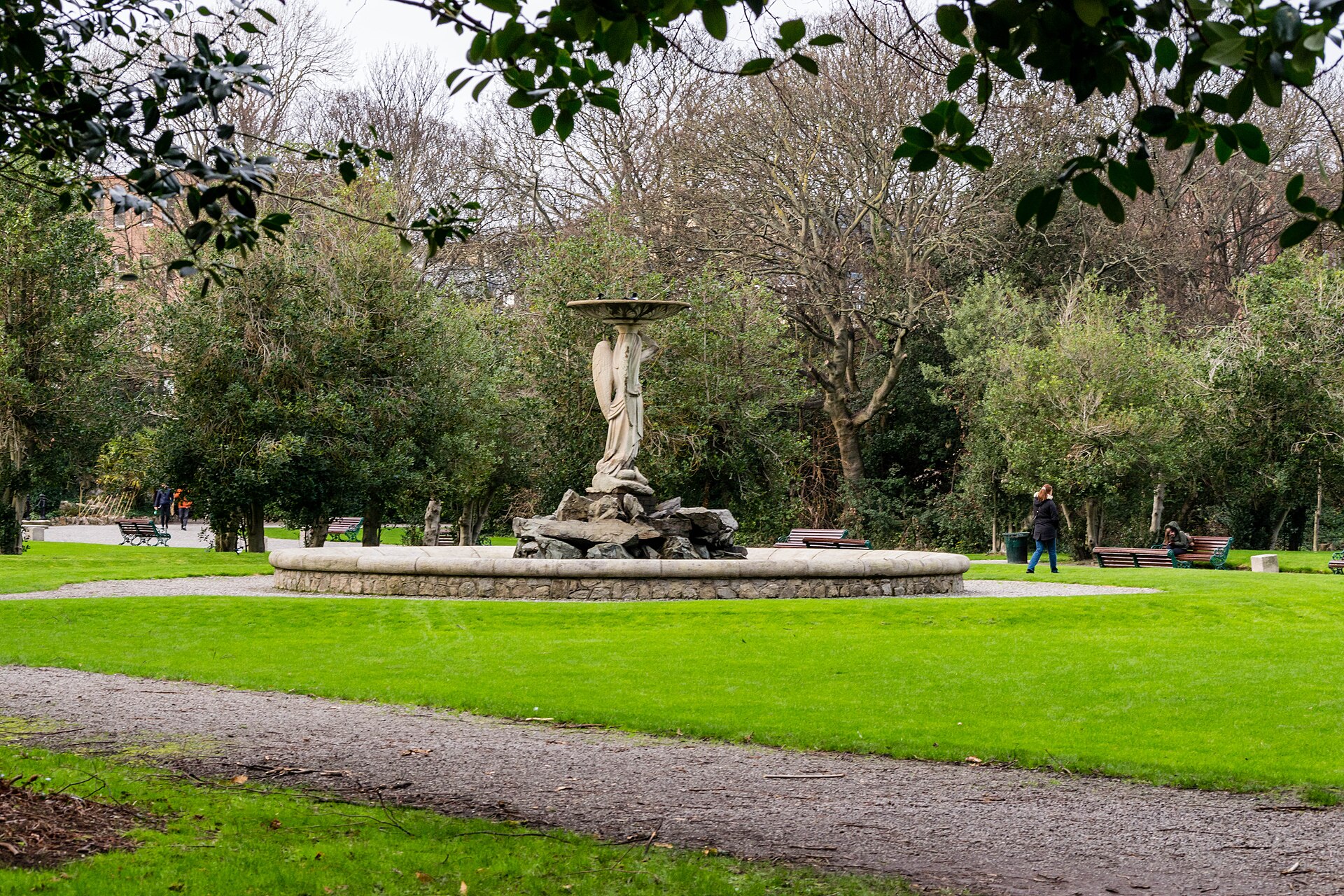
Dublin’s “secret garden”, hidden behind high walls a couple of minutes south of the Green, behind the National Concert Hall. Designed in the 1860s, it has a sunken lawn, a rustic grotto and cascade, a little box maze, fountains, a rosarium and almost no tourists. In summer it hosts outdoor concerts. Enter from Clonmel Street, off Harcourt Street, or through the back of the MoLI café. Bring a sandwich.
Merrion Square
A Georgian square with a park in the middle, surrounded by red-brick houses with famous coloured doors. Oscar Wilde grew up at No. 1, and his reclining statue lounges on a rock in the corner of the park, looking as though he’s just said something cruel and is waiting for you to get it. Across the road is the Joker’s Chair, a bronze memorial to the comedian Dermot Morgan. On weekends artists hang their paintings on the railings for sale. The square is right beside the free National Gallery.
St Patrick’s Park
The small park beside St Patrick’s Cathedral, on the spot where St Patrick is said to have baptised converts, with a “Literary Parade” of plaques to Irish writers along one wall. A good place to sit before or after the cathedral. See Dublin’s churches and cathedrals.
The Garden of Remembrance
Not a park for picnics, but the quietest place on the north side of the centre. See our Garden of Remembrance guide.
Blessington Street Basin
A hidden former reservoir in the north inner city, now a small walled park around a lake, with swans and benches. It once supplied water to the north side of the city and later to its distilleries. Almost nobody outside the area knows it’s there.
The Phoenix Park
One of the largest enclosed city parks in Europe, about 707 hectares (1,750 acres), more than twice the size of New York’s Central Park. It was created as a royal deer park in the 1660s, and a herd of several hundred wild fallow deer still lives here. You’ll usually find them in the open grassland near the Papal Cross.
- The Wellington Monument, a 62-metre obelisk near the main gate, the tallest in Europe.
- The Papal Cross, marking where Pope John Paul II said Mass to more than a million people in 1979.
- Áras an Uachtaráin, the President’s house, with free tours on Saturdays from the Phoenix Park Visitor Centre. See castles and stately homes.
- Farmleigh, the former Guinness family house, now the state’s guesthouse, with gardens open to the public.
- The People’s Flower Gardens, Victorian flower beds and a lake near the Parkgate Street entrance.
- Dublin Zoo, one of the oldest zoos in the world.
It will trick you into a 12km walk, so hire a bike near the main gate if you want to see more of it. We’ve written a whole post: how to do the Phoenix Park properly. The main gate is at Parkgate Street, about 20 minutes’ walk from the Ha’penny Bridge or a short Luas ride to Heuston.
The National Botanic Gardens, Glasnevin
Founded in 1795 and still a working scientific institution, with around 20,000 plants and some of the finest Victorian glasshouses in the world, including Richard Turner’s great curvilinear range and the Palm House. There’s also a rose garden, a rock garden, a river walk along the Tolka, a yew walk and a lot of trees older than the state. It’s free to enter, every day except Christmas Day.
- Winter hours: 9am to 4:30pm on weekdays, 10am to 4:30pm at weekends and on public holidays.
- Summer hours: 9am to 5pm on weekdays, 10am to 6pm at weekends and on public holidays.
- Guided tours usually need a paid ticket. No picnics, ball games or bikes.
It’s right beside Glasnevin Cemetery, so do both on the same trip; our Glasnevin guide has the buses. The Botanic Gardens also run a second garden at Kilmacurragh in County Wicklow.
The Irish National War Memorial Gardens, Islandbridge
Designed by Sir Edwin Lutyens in memory of the 49,400 Irish soldiers who died in the First World War, with sunken rose gardens, granite book rooms and avenues down to the Liffey. Formal, peaceful, beautiful, and visited by almost nobody. Open from 8am on weekdays and 10am at weekends, closing at dusk. It’s across the river from the Phoenix Park, so combine the two.
IMMA and the Royal Hospital Kilmainham
The formal gardens and meadows of the 17th-century Royal Hospital, home of the free Irish Museum of Modern Art, are open to walk. They’re a five-minute walk from Kilmainham Gaol.
Southside suburbs
- Herbert Park, Ballsbridge: an Edwardian park on the site of the 1907 Irish International Exhibition, with a duck pond and tennis courts. A lovely walk from the city along the Grand Canal.
- Marlay Park, Rathfarnham: big, varied and family-friendly, with woodland walks, a walled garden at Marlay House and a good playground. It’s where the Wicklow Way begins, and where big summer concerts are held.
- Bushy Park, Terenure: a local favourite with a pond, woods along the River Dodder and a good playground.
- The Dodder Valley and Tymon Park: long riverside and parkland walks across the south-west suburbs, for walkers and runners.
Northside suburbs
- St Anne’s Park, Raheny: a huge park on the old Guinness estate, with a famous rose garden, Victorian follies, woodland, and Bull Island and Dollymount Strand across the road.
- Bull Island: a 5km sandy island and nature reserve, with Dollymount Strand on one side and huge flocks of wading birds on the other in winter.
- Fairview Park: on the way to Clontarf and Croke Park, with the coastal path along Dublin Bay beyond.
- Father Collins Park, Clongriffin: a modern park powered by its own wind turbines. One for the locals.
Further out
- Malahide Castle and Gardens: 260 acres of parkland, free to walk, plus a ticketed walled botanic garden and butterfly house. See our Malahide day trip.
- Howth: the cliff walk and rhododendrons. See Howth.
- Killiney Hill: one of the best views in Ireland. See Dalkey and Killiney.
- Powerscourt in Wicklow: one of the great gardens of Europe. See castles and stately homes and the Wicklow Mountains.
A green day in Dublin
- Morning: St Stephen’s Green, then the Iveagh Gardens and a coffee at the MoLI garden café.
- Walk down to Merrion Square and the National Gallery.
- Afternoon: the Phoenix Park, with a bike, the deer and the People’s Gardens, and the War Memorial Gardens across the river if you’ve energy left.
Tips
- Parks close at dusk, and the city-centre ones are locked. The closing time is usually on a sign by the gate.
- Bring a layer. The sun can disappear before you’ve finished your sandwich.
- Dogs must be on leads in most city parks, and aren’t allowed in the Botanic Gardens except guide dogs.
- Dublin Bikes and other bike-share schemes have stations near the main city parks. See getting around Dublin.
Travelling with a dog? See our list of pet-friendly hotels in Dublin.
Frequently asked questions
What is the most beautiful park in Dublin?
St Stephen’s Green is the classic, but the Iveagh Gardens, the National Botanic Gardens and the War Memorial Gardens are quieter and, many locals would say, lovelier.
Where can you see deer in Dublin?
In the Phoenix Park, which has a herd of several hundred wild fallow deer, often near the Papal Cross. Don’t feed them.
Are the Botanic Gardens free?
Yes. The National Botanic Gardens in Glasnevin are free to enter every day except Christmas Day. Guided tours are usually paid.
What time does St Stephen’s Green close?
The city-centre parks close at dusk, so closing times change through the year. The time is posted on the gates.
Is the Phoenix Park bigger than Central Park?
Yes, more than twice the size, at about 707 hectares.
More in our guide to things to do in Dublin.