Researched and checked by Tourist Information Dublin · How we research
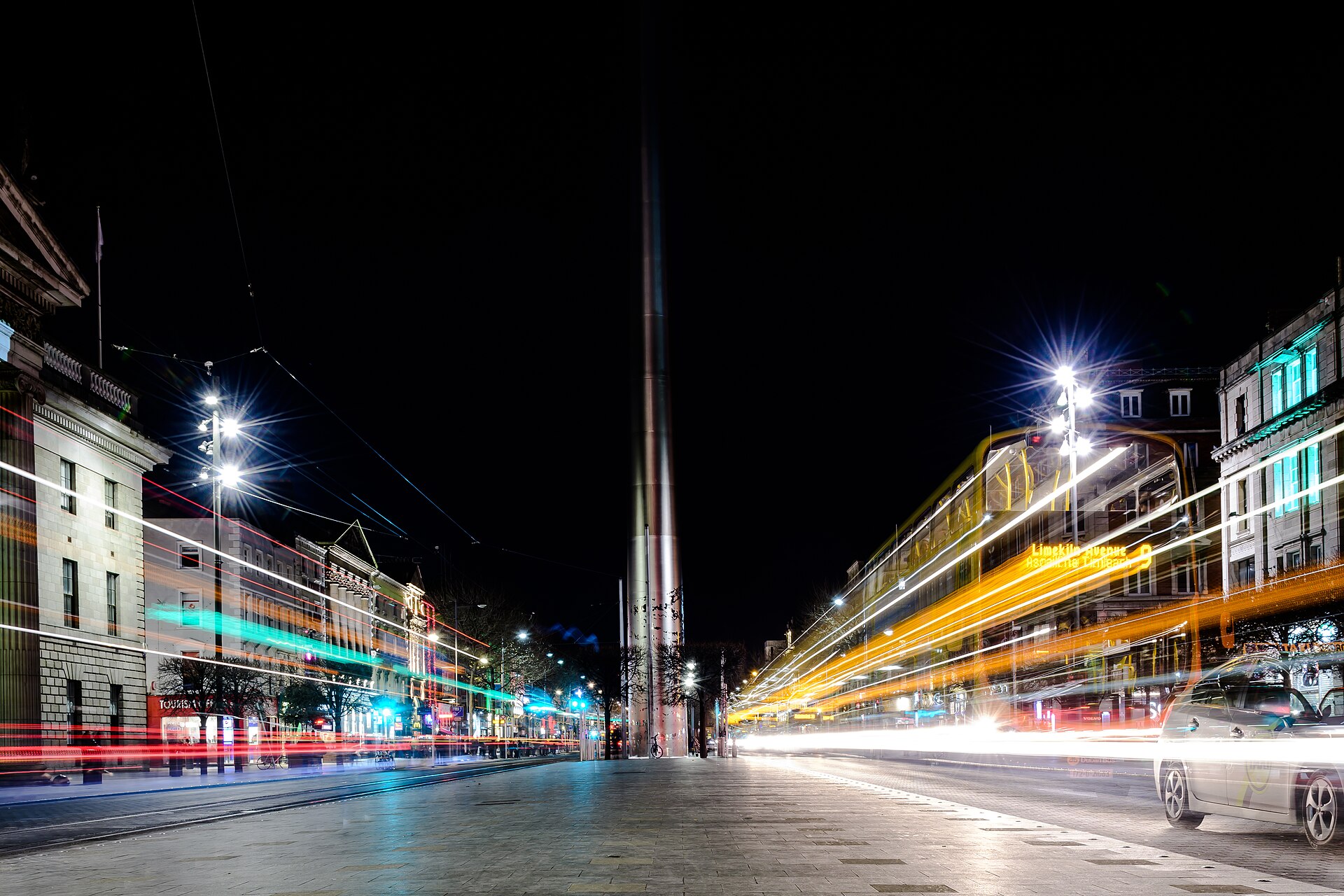

Some things in Dublin make sense. The Liffey. The GPO. The unwritten law that you never sit upstairs on the bus unless the downstairs is full.
And then there’s the Spire.
A 120-metre stainless steel needle sticking out of O’Connell Street as if someone dropped it from a great height and walked off. You see it before you see anything else. It glints. It’s pointy. And there’s nothing at the bottom explaining what it is, why it’s there, or whether you’re meant to salute it or just walk past and pretend it’s normal.
Let’s break it down.
So what actually is the Spire?
Its official name is the Monument of Light, which sounds poetic. Don’t go looking for hidden meaning. It’s not a memorial or a religious symbol, and it doesn’t point at anything in particular.
It’s a huge modern sculpture, designed by the architect Ian Ritchie and put up as part of the regeneration of O’Connell Street, which had lost a lot of its dignity by the end of the 20th century.
It went up in sections at the end of 2002 and was finished in January 2003. It’s about 120 metres tall, the tallest structure in the city centre, and tapers from three metres wide at the base to about 15cm at the tip. At night the top is lit up, which is the “light” part of Monument of Light. When the lights work.
Why is it there?
Here’s the messy bit.
Before the Spire, the same spot was home to Nelson’s Pillar, a granite column with a statue of Admiral Horatio Nelson on top, put up in 1809. Nelson had a lot to do with Trafalgar and very little to do with Dublin, and his pillar stood in the middle of the main street of an independent Ireland for decades, to the irritation of many.
In March 1966, just before the 50th anniversary of the Easter Rising, republicans blew the top off it. The army removed the stump a few days later, with a second explosion that broke more windows on O’Connell Street than the first.
Nelson’s head survived and is now kept by Dublin City Libraries. For years it was on show in the old Dublin Civic Museum.
The site stayed awkwardly empty for decades, with various fountains and plans that came and went, until the city decided on something new and enormous for the Millennium. It arrived a little late.
The cost was around €4 million. The public reaction was a mixture of squinting and disbelief.
The nicknames (because this is Dublin)
Dubliners are incapable of letting anything serious stay serious, and the Spire was renamed almost before the crane had left. Among the politer ones:
- The Stiletto in the Ghetto
- The Nail in the Pale
- The Pin in the Bin
- The Stiffy by the Liffey
- The Spike
There are others. You’ll hear them.
Is it worth visiting?
It’s unavoidable. If you’re anywhere in the city centre and you can’t see a 120-metre pole gleaming in the sky, you’re either in a pub basement or facing the wrong way.
You can’t go up it, you can’t go in it, and there’s no gift shop. But as a piece of modern Dublin, it’s oddly essential. It says something about the city: always somewhere between ancient history and a bold leap at the future, and now and then landing on its stainless steel backside.
And it’s the best meeting point in town. “Where are you?” “At the big shiny thing.” Done.
Spire facts
- Height: about 120 metres, the tallest structure in Dublin city centre.
- Width: three metres at the base, about 15cm at the tip.
- Material: stainless steel, in sections lifted into place by crane.
- The base: the lowest part has a textured pattern, so it looks different up close.
- The top: perforated with thousands of small holes and lit from inside, so it glows at night.
- It moves: like any very tall, thin structure, it sways slightly in strong wind. You won’t notice.
- Cleaning: specialist climbers abseil down it every so often to clean it.
- Cost: about €4 million.
What it replaced: Nelson’s Pillar
Nelson’s Pillar was a Doric column more than 35 metres tall, with a viewing platform that people climbed for a few pence to look out over the city. For over a century it was the city’s main tram terminus and meeting point, “under the Pillar”. Nobody was ever convicted of blowing it up. You can see Nelson’s stone head at the Dublin City Library and Archive on Pearse Street. The full story of the statues on the street, including the ones Dublin blew up, is in our guide to Dublin’s statues.
What’s around it
- The GPO, right beside it, headquarters of the 1916 Rising and home to the GPO Museum. Look for the bullet marks on the columns.
- The statues along O’Connell Street, including Daniel O’Connell, Jim Larkin and the James Joyce statue on North Earl Street. See Dublin’s statues.
- Henry Street for shopping, and Moore Street market. See shopping in Dublin.
And before you go, read how to cross O’Connell Street without getting killed or conned.
More in our guide to things to do in Dublin.
Planning your trip? Just up the street is the GPO: see GPO Witness History, or plan the rest of your day with things to do in Dublin.