Researched and checked by Tourist Information Dublin · How we research

The Liffey cuts Dublin in half, so the city depends on its bridges. There are more than twenty across the river in and around the city, and most visitors only notice two of them.
Here’s the full cast, from the famous to the forgotten.
The Ha’penny Bridge
The white cast-iron arch, for pedestrians only, opened in 1816. Its official name is the Liffey Bridge, but nobody calls it that. It’s the Ha’penny because crossing it once cost a halfpenny toll.
It’s on every postcard and in a thousand proposal photographs, and it’s described in plenty of blogs as a “hidden gem”, despite being about as hidden as the airport. It’s also one of the few things in the city centre that hasn’t been knocked down or made worse, so give it its moment.
O’Connell Bridge
The big, busy one at the bottom of O’Connell Street, said to be the only bridge in Europe that’s wider than it is long. Visitors occasionally ask if it’s broken. It’s not. That’s just the shape. Look east from here for the Custom House, and west for the Ha’penny.
The Millennium Bridge
A plain modern footbridge into Temple Bar, built for the Millennium. Nobody gets excited about it, but it’s useful when the Ha’penny is crowded, and it has the best view of the Ha’penny.
The Rosie Hackett Bridge
The newest city-centre bridge, opened in 2014, linking Marlborough Street and Hawkins Street. It’s for buses, trams, cyclists and pedestrians only. It’s named after Rosie Hackett, a trade unionist and veteran of the 1916 Rising, and it’s the only Liffey bridge named after a woman. Quiet, modest, under-appreciated.
The Samuel Beckett Bridge
Down in the Docklands: Santiago Calatrava’s white cable-stayed bridge, designed to look like a harp lying on its side. It swings open to let ships through. Beautiful at night.
The Seán O’Casey Bridge
A footbridge in the Docklands that also swings open for boats. Not ideal if you’re halfway across with a coffee.
The James Joyce Bridge
Another Calatrava bridge, further west near Usher’s Island, opposite the house where Joyce set his great story “The Dead”. Literary types will want to see it. See James Joyce for people who’ll never read Joyce.
Further west
Rory O’More Bridge, a cast-iron arch near Heuston, and Seán Heuston Bridge, a Victorian iron bridge now carrying the Luas, are worth a look if you’re walking to the Guinness Storehouse or the Phoenix Park.
And the one everyone forgets: Butt Bridge
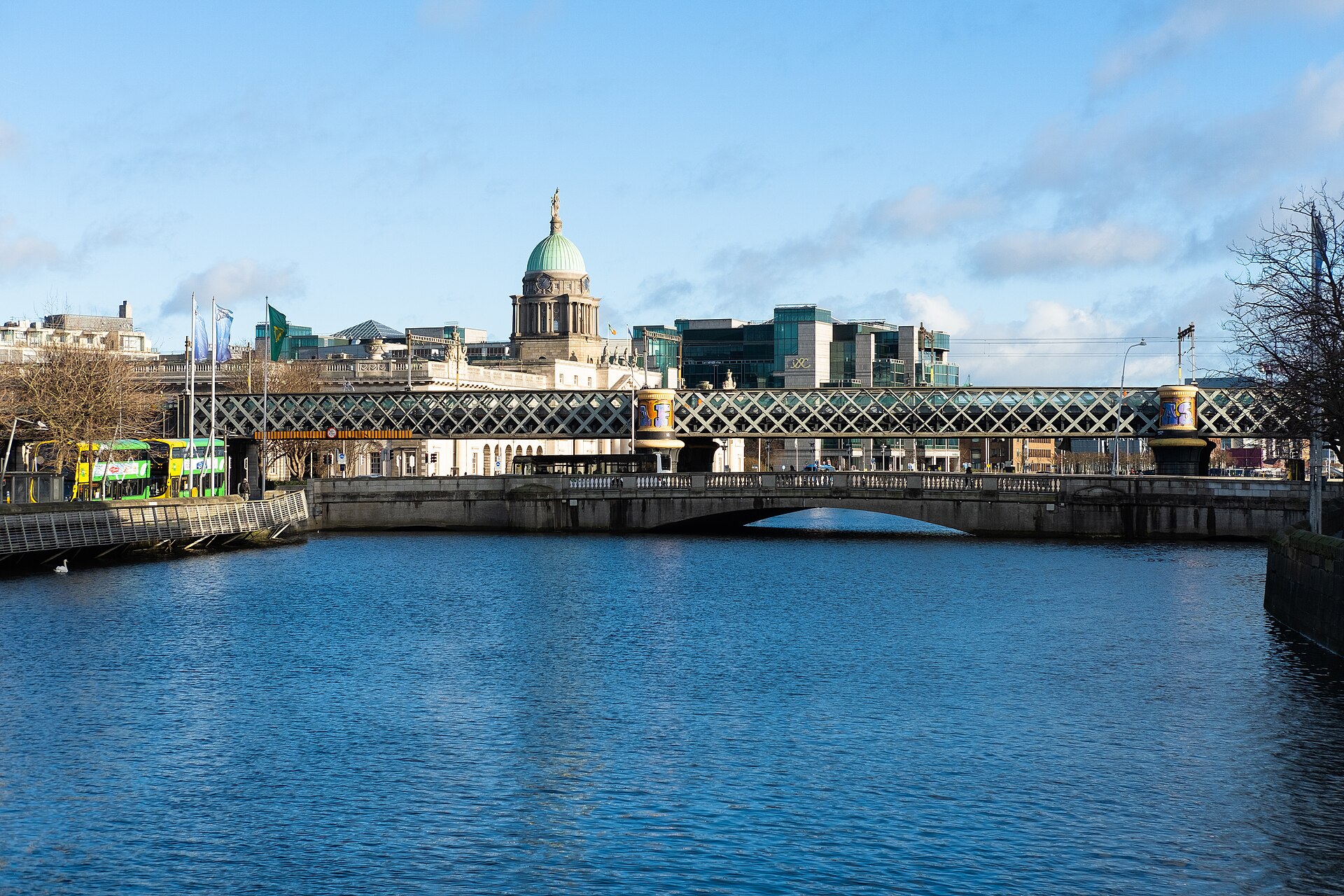
Yes, that’s what it’s called. It’s named after Isaac Butt, the 19th-century barrister and politician who founded the Home Rule movement. It links Beresford Place by the Custom House with Tara Street on the south quays, right under the railway bridge known as the Loopline, which blocks the view of the Custom House and has been annoying Dubliners since the 1890s.
It’s not hidden and it’s not small. It’s just forgettable. No view, no performance, no photographs. Traffic most of the day. People rushing to work, dragging suitcases, crossing without thinking.
It doesn’t try to be anything. It’s just a bridge doing its job. Which is a fairly Dublin thing altogether.
All the Liffey bridges, west to east
For the completists, here are the main bridges in the city, from Heuston to the sea:
| Bridge | Opened | Worth knowing |
|---|---|---|
| Seán Heuston Bridge | 1828 | Iron bridge by Heuston Station, now carries the Luas |
| Frank Sherwin Bridge | 1982 | Concrete road bridge, named after a city councillor |
| Rory O’More Bridge | 1859 | Cast-iron arch, once named after Queen Victoria |
| James Joyce Bridge | 2003 | Calatrava, opposite the house in “The Dead” |
| Mellows Bridge | 1768 | The oldest bridge still in use in the city centre |
| Father Mathew Bridge | 1818 | On the site of Dublin’s first bridge, by the Viking ford |
| O’Donovan Rossa Bridge | 1816 | Stone arches by the Four Courts |
| Grattan Bridge | 1875 | Wide, with ornate seahorse lamps, at the foot of Capel Street |
| Millennium Bridge | 1999 | Footbridge into Temple Bar |
| Ha’penny Bridge | 1816 | The famous one |
| O’Connell Bridge | 1880 (rebuilt) | Wider than it is long |
| Rosie Hackett Bridge | 2014 | The only one named after a woman |
| Butt Bridge | 1932 (rebuilt) | The forgotten one |
| Loopline Bridge | 1891 | Railway bridge, blocks the Custom House view |
| Talbot Memorial Bridge | 1978 | Named after Matt Talbot, the Dublin labourer revered for giving up drink |
| Seán O’Casey Bridge | 2005 | Swinging footbridge |
| Samuel Beckett Bridge | 2009 | Calatrava’s harp |
| Tom Clarke Bridge | 1984 | The East Link toll bridge, which lifts for ships |
Bridge facts to drop at the pub
- Father Mathew Bridge stands near the spot where the Vikings, and probably people before them, forded the river. Dublin’s Irish name, Baile Átha Cliath, means “the town of the hurdle ford”.
- Mellows Bridge is the oldest bridge still in use in the city centre, from the 1760s.
- The Ha’penny Bridge was cast in Shropshire, in England, and shipped over in pieces. The toll was dropped in 1919.
- O’Connell Bridge was originally Carlisle Bridge, designed by James Gandon in the 1790s, and widened in the 1870s into the near-square it is now.
- The Samuel Beckett Bridge was built in Rotterdam and floated across the sea to Dublin in one piece.
- Grattan Bridge has cast-iron seahorses on its lamp standards. Look down.
The best bridge photos
- The Ha’penny Bridge from the Millennium Bridge, at dusk when the lamps come on.
- The Samuel Beckett Bridge from the Seán O’Casey Bridge, with the Convention Centre behind.
- The Custom House from Rosie Hackett Bridge, without the Loopline in the way, more or less.
- The view west from O’Connell Bridge, with every bridge lined up along the river.
See them on foot
The best way to see the bridges is to walk the quays from the Four Courts to the Docklands. Our route: a walk along the Liffey quays and Docklands. For the river itself, see the River Liffey.
Planning your trip? Most of the bridges are on our quays and Docklands walk.