Researched and checked by Tourist Information Dublin · How we research

Dublin has hundreds of statues. Pigeons sit on all of them, tourists photograph most of them, and almost nobody can tell you who half of them are. Some were blown up, some were moved for the tram, one is made of jade, and most have a rude nickname.
This is the complete visitor’s guide: who’s who, where to find them, who made them, the stories behind them, the statues Dublin got rid of, and a self-guided statue walk with measured walking times. Facts are from Dublin City Council’s history of the O’Connell Street monuments and other published records, and walking times from Google Maps, checked November 2026.
The famous ones at a glance
| Statue | Where | Sculptor | Year | Nickname |
|---|---|---|---|---|
| Daniel O’Connell | O’Connell Street, by the bridge | John Henry Foley and Thomas Brock | 1882 | |
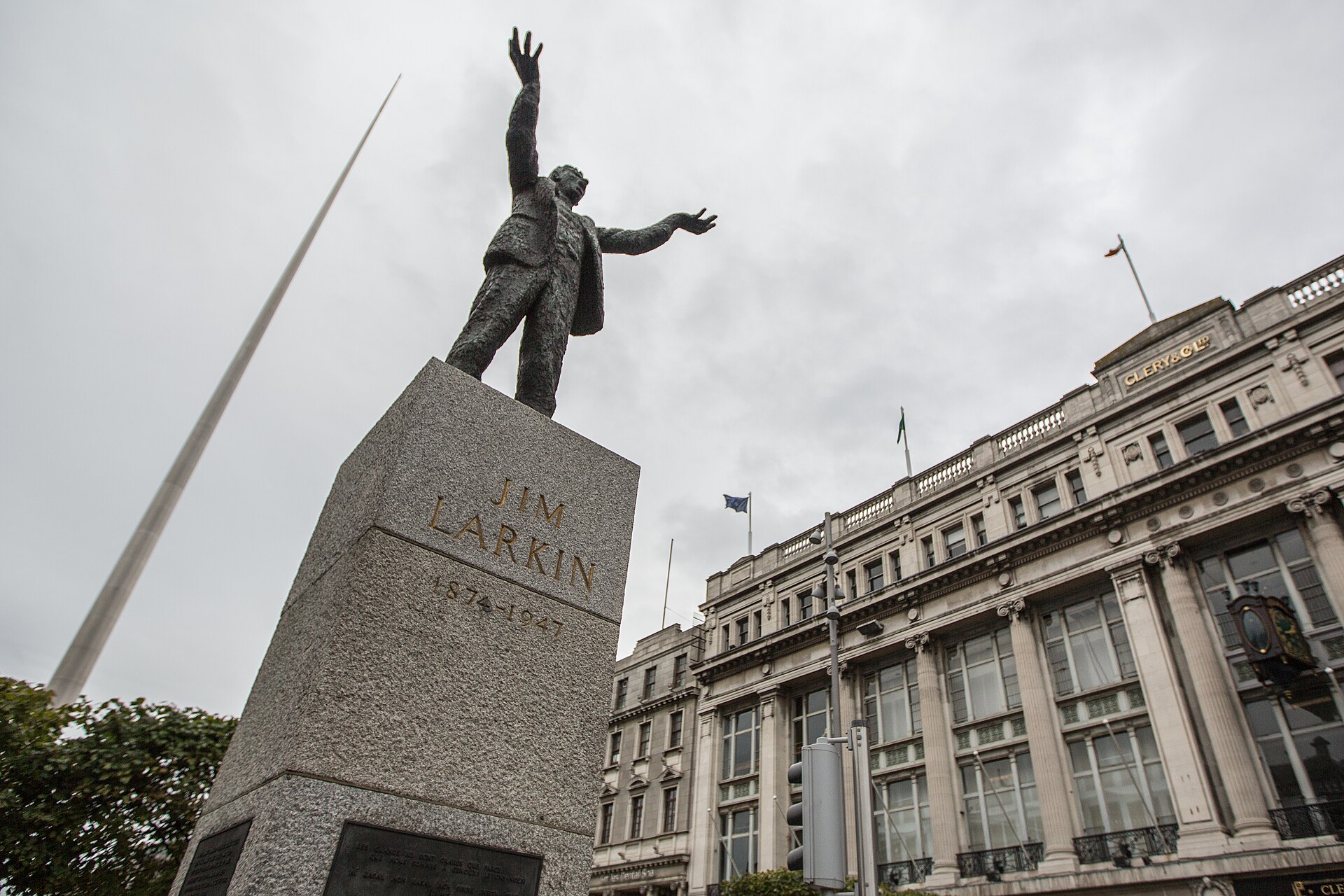
| Jim Larkin | O’Connell Street, opposite the GPO | Oisín Kelly | 1979 | |
| Charles Stewart Parnell | Top of O’Connell Street | Augustus Saint-Gaudens | 1911 | |
| James Joyce | North Earl Street | Marjorie FitzGibbon | 1990 | The Prick with the Stick |
| The Spire | O’Connell Street | Ian Ritchie Architects | 2003 | The Stiletto in the Ghetto |
| Molly Malone | Suffolk Street | Jeanne Rynhart | 1988 | The Tart with the Cart |
| Phil Lynott | Harry Street, off Grafton Street | Paul Daly | 2005 | The Ace with the Bass |
| Oscar Wilde | Merrion Square | Danny Osborne | 1997 | The Quare on the Square |
| Patrick Kavanagh | Grand Canal, Wilton Terrace | John Coll | 1991 | The Crank on the Bank |
| Wolfe Tone | St Stephen’s Green | Edward Delaney | 1967 | Tonehenge |
| Meeting Place | Lower Liffey Street | Jakki McKenna | 1988 | The Hags with the Bags |
| Anna Livia | Croppies Acre, Wolfe Tone Quay | Éamonn O’Doherty | 1988 | The Floozie in the Jacuzzi |
| Famine | Custom House Quay | Rowan Gillespie | 1997 |
O’Connell Street: the city’s open-air history book
Dublin’s main street has eight monuments down its central island, from O’Connell at the river to Parnell at the top. Read them in order and you get the story of Irish nationalism from the 1820s to the 20th century.
Daniel O’Connell (1882)
The huge monument at the bridge end of the street honours “the Liberator”, the campaigner who won Catholic Emancipation in 1829. The street was renamed after him in 1924; before that it was Sackville Street. The foundation stone was laid in 1864, and all sixty designs entered in the competition were rejected before the commission went to John Henry Foley. Foley died in 1874, and Thomas Brock finished it. It was unveiled on 15 August 1882.
O’Connell, in bronze, stands 12 feet tall above a frieze of figures, and around the base sit four winged Victories representing Patriotism, Courage, Eloquence and Fidelity. Look closely at two of them: the bullet holes from the fighting of 1916 to 1922 are still there.
William Smith O’Brien (1870)
A white marble figure by Thomas Farrell of the leader of the failed Young Ireland rising of 1848, who was sentenced to death for high treason, had the sentence commuted and was transported to Van Diemen’s Land, now Tasmania. Unveiled in December 1870 at the junction with D’Olier Street, it was the first monument in Dublin to someone who had taken up arms against British rule. It was moved to O’Connell Street in 1929 because of the traffic.
Sir John Gray (1879)
Another Thomas Farrell marble, of the owner of the nationalist Freeman’s Journal newspaper, whose offices were nearby. Gray’s lasting gift to the city was clean water: he drove the scheme that brought a water supply to Dublin in 1868. The original design had allegorical figures of Ireland and Patriotism too, but only Gray himself was ever made.
Jim Larkin (1979)
The best statue on the street. Oisín Kelly’s bronze shows the trade union leader of the 1913 Lockout mid-speech, arms flung wide over the crowd. It was unveiled by President Patrick Hillery on 15 June 1979, outside the old Clerys department store. The plinth carries his famous line, “The great appear great because we are on our knees. Let us rise!”, in English, Irish and French, with quotations from Seán O’Casey and Patrick Kavanagh. The birth year on it was originally carved as 1876; a historian showed in 1980 that it was 1874, and it has since been corrected.
Father Theobald Mathew (1893)
The “Apostle of Temperance”, who persuaded millions of Irish people to take a pledge against drink, in limestone by Mary Redmond, one of the few women sculptors on Dublin’s streets. Its foundation stone was laid in 1890, on the centenary of his birth. A councillor’s proposal to close the city’s pubs for the unveiling was ruled out of order. The statue was removed in 2014 for the Luas works and returned in 2018 to a new spot near the Spire.
The Spire (2003)
The 120-metre stainless steel needle, officially the Monument of Light, by Ian Ritchie Architects, stands where Nelson’s Pillar stood until republicans blew it up in 1966. The site stood empty for decades before the Spire went up in 2003. Dubliners call it the Stiletto in the Ghetto, among other things. More in what the hell is the Spire?
Cú Chulainn, inside the GPO (1911)
Step inside the General Post Office to see Oliver Sheppard’s bronze of the dying mythical hero, who tied himself to a stone so he could die on his feet. Sheppard made it in 1911, before the Rising, but in 1935 it was installed in the GPO as the national memorial to the rebels of 1916. See the GPO Museum.
Charles Stewart Parnell (1911)
At the top of the street, a bronze Parnell stands in front of a tall granite obelisk, by the Dublin-born American sculptor Augustus Saint-Gaudens. The foundation stone was laid in 1899, and a fire in Saint-Gaudens’s studio in 1904 destroyed everything except the head. The monument was unveiled on 1 October 1911, with bronze plaques of the counties and provinces round the base and Parnell’s words on the plinth: “No man has a right to fix the boundary to the march of a nation.”
James Joyce, North Earl Street (1990)
Just off O’Connell Street, near the Spire, Joyce leans on his cane in a hat, looking unimpressed. Marjorie FitzGibbon’s bronze was unveiled on Bloomsday 1990. It was put on a deliberately low plinth so he’d stand at eye level with passers-by, and the local business groups who paid for it justified the location by Joyce’s brief spell managing the Volta Cinema nearby. Its nickname, the Prick with the Stick, is one of the city’s best known. More in James Joyce for people who’ll never read Joyce.
The north side and the quays
Meeting Place, Lower Liffey Street (1988)
Two bronze women sit on a bench chatting, shopping bags at their feet, beside the Ha’penny Bridge. Jakki McKenna made it for the Dublin Millennium in 1988, and Dubliners immediately named it the Hags with the Bags.
Anna Livia, Croppies Acre (1988)
Éamonn O’Doherty’s reclining woman in a pool of water represents the River Liffey, Joyce’s Anna Livia Plurabelle. She was made for the Millennium too, and put in the middle of O’Connell Street, where she was quickly christened the Floozie in the Jacuzzi. She was removed in 2001 to make way for the Spire, and since 2011 she has rested in the Croppies Acre memorial park on Wolfe Tone Quay, opposite Collins Barracks.
The Famine sculptures, Custom House Quay (1997)
Rowan Gillespie’s gaunt bronze figures shuffle along the quay towards the emigrant ships, carrying bundles and a child, with a starving dog behind them. It’s the most moving piece of public art in Dublin. A companion set by Gillespie stands in Toronto, where many of the emigrants landed. See the Famine Memorial.
Also on the north side
- James Connolly, Beresford Place, by Éamonn O’Doherty (1996): the 1916 leader and socialist, in front of Liberty Hall.
- Children of Lir, Garden of Remembrance, by Oisín Kelly: the children of the legend, turning into swans. See the Garden of Remembrance.
- Brendan Behan, Royal Canal near Drumcondra, by John Coll (2003): the playwright sitting on a bench by the canal.
- Luke Kelly, Sheriff Street, by Vera Klute (2019): a giant head of the Dubliners singer, with a second Luke Kelly by John Coll on South King Street, unveiled the same year.
- The Linesman, City Quay, by Dony MacManus (1999): a docker hauling a rope, for the Docklands’ working past.
- Matt Talbot, City Quay, by James Power (1988): the Dublin labourer revered for giving up drink and devoting his life to prayer.
Trinity College and College Green
- Oliver Goldsmith (1864) and Edmund Burke (1868), by John Henry Foley, stand either side of Trinity’s front gate: the writer of She Stoops to Conquer and the political philosopher, both Trinity graduates. See Trinity College and the Book of Kells.
- Henry Grattan (1876), also by Foley, faces the old Irish Parliament House, now the Bank of Ireland, mid-speech.
- Thomas Davis (1966), by Edward Delaney, the Young Ireland writer of “A Nation Once Again”, with a fountain of four angels.
- Thomas Moore (1857), by Christopher Moore, on College Street, the poet of Moore’s Irish Melodies.
Grafton Street
Molly Malone (1988)
“In Dublin’s fair city, where the girls are so pretty…” Jeanne Rynhart’s bronze of the fishmonger from the song was unveiled by the Lord Mayor in 1988, when the Dublin Millennium Commission backed a claim that the real Molly was a Mary Malone who died on 13 June 1699, and declared 13 June Molly Malone Day. Nobody has ever proved she existed, and the song may not even have been written in Ireland.
The statue stood at the bottom of Grafton Street until April 2014, when it was taken away for the Luas works, and in July 2014 it was put back round the corner on Suffolk Street, outside the old St Andrew’s Church. Her low-cut 17th-century dress earned her the nickname the Tart with the Cart. Tourists rub her chest “for luck”, a tradition with no history behind it at all, and the polished bronze shows it. Please don’t.
Phil Lynott (2005)
Just off Grafton Street on Harry Street, the Thin Lizzy frontman stands with his bass guitar outside Bruxelles, one of his favourite pubs, where the band held meetings. Paul Daly’s life-size bronze was commissioned by the Róisín Dubh Trust and unveiled in 2005 by Phil’s mother, Philomena. It was badly damaged and spent time away for repairs before being reinstated in May 2013. Dubliners call it the Ace with the Bass, one of the few affectionate nicknames.
St Stephen’s Green
The Green has more memorials than anywhere else in the city. Enter at the top of Grafton Street.
- Fusiliers’ Arch (1907), the main gate, is a memorial to the Royal Dublin Fusiliers who died in the Boer War, nicknamed Traitors’ Gate.
- Wolfe Tone (1967), by Edward Delaney, the leader of the 1798 rebellion, stands in front of a ring of tall granite slabs that Dubliners nicknamed Tonehenge. Loyalists blew it up in 1971, and Delaney repaired it. His Famine memorial of starving figures stands just behind.
- Knife Edge (1961), a Henry Moore bronze, is the memorial to W. B. Yeats.
- The Three Fates (1956), by Josef Wackerle, were a gift from Germany in thanks for Irish help to German children after the Second World War.
- Lord Ardilaun (1891), by Thomas Farrell: Arthur Guinness, the brewing heir who paid to landscape the Green and opened it to the public.
- James Joyce (1982), a bust by Marjorie FitzGibbon, opposite his old university at Newman House.
- James Clarence Mangan (1909), by Oliver Sheppard, the poet of “Dark Rosaleen”.
- Robert Emmet, by Jerome Connor, the leader of the 1803 rising, opposite the house where he was born.
- Constance Markievicz, a bust of the 1916 leader, who fought in the Green itself during the Rising, and Rabindranath Tagore (2011), the Indian poet.
More on the Green in Dublin parks and gardens.
Merrion Square
Oscar Wilde (1997)
Wilde lounges on a quartz boulder in the north-west corner of Merrion Square, smirking across at No. 1, the house he grew up in. Danny Osborne’s sculpture, commissioned by the Guinness Ireland Group, is made of coloured stone from three continents, because marble alone wasn’t flamboyant enough: the jacket is green nephrite jade from Canada, the collar and cuffs pink thulite from Norway, the trousers blue pearl granite, and the head and hands glazed porcelain. Two companion figures face him, his pregnant wife Constance and the god Dionysus, on pillars covered in his own quotations. Its nicknames include the Quare on the Square and the Fag on the Crag.
Also in Merrion Square
- Michael Collins, a bust by Dick Joynt (1990).
- The Joker’s Chair (2002), a bronze chair by Catherine Greene in memory of the comedian Dermot Morgan, Father Ted himself.
- Bernardo O’Higgins (1995), a gift from Chile to honour its Irish-descended liberator.
The canals
Patrick Kavanagh (1991)
The poet sits on a bench by the Grand Canal on Wilton Terrace, between Baggot Street and Leeson Street bridges, arms folded, hat beside him, looking at the water. He’d asked for exactly this in his sonnet “Lines Written on a Seat on the Grand Canal, Dublin”, which asks to be remembered by the water with nothing grander than a canal-side seat. John Coll’s life-size bronze has room beside him on the bench, so sit down. The plaque quotes another of his canal poems, “Canal Bank Walk”. It’s nicknamed the Crank on the Bank.
Brendan Behan (2003)
On the Royal Canal on the north side, near Drumcondra, John Coll’s bronze of the playwright and drinker sits on a bench, so the city’s two great canal-side poets each have a seat.
Statues Dublin got rid of
Dublin has a long tradition of removing, blowing up or quietly shipping away statues of British figures.
- Nelson’s Pillar, O’Connell Street (1809 to 1966): a column more than 35 metres tall, topped by Admiral Nelson, blown up by republicans in March 1966, the 50th anniversary year of the Rising. Nelson’s stone head survives in the Dublin City Library and Archive on Pearse Street.
- William of Orange, College Green (1701 to 1929): Grinling Gibbons’s equestrian statue was a target for centuries, damaged by an explosion in 1928, removed in 1929 and melted down in 1946.
- George II, St Stephen’s Green (1758 to 1937): blown up on 13 May 1937, around the coronation of George VI.
- Lord Gough, Phoenix Park (1878 to 1957): Foley’s equestrian statue was blown up in 1957. Restored, it now stands at Chillingham Castle in England.
- Queen Victoria, Leinster House (1904 to 1948): removed in 1948 and given to Sydney, Australia, where it went on display in 1987. Two of its allegorical figures are still at Leinster House.
- Sir Philip Crampton, College Street (1862 to 1959): a fountain topped by a strange leafy sculpture nicknamed the Pineapple or the Cauliflower, which collapsed in 1959.
Dublin’s statue nicknames
Dubliners give rhyming nicknames to almost every new monument. Most aren’t used in daily life, but they’re part of the city’s humour:
- Molly Malone: the Tart with the Cart, or the Trollop with the Scallops.
- James Joyce, North Earl Street: the Prick with the Stick.
- The Spire: the Stiletto in the Ghetto.
- Anna Livia: the Floozie in the Jacuzzi.
- Meeting Place: the Hags with the Bags.
- Oscar Wilde: the Quare on the Square, the Fag on the Crag, or the Queer with the Leer.
- Patrick Kavanagh: the Crank on the Bank.
- Phil Lynott: the Ace with the Bass.
- Wolfe Tone’s granite slabs: Tonehenge.
- Fusiliers’ Arch: Traitors’ Gate.
A self-guided Dublin statue walk
This route takes in the best statues from north to south, about an hour of walking (4.2km), or two to two and a half hours with stops. Walking times are from Google Maps.
| Stop | Statues | Walk to next |
|---|---|---|
| 1. Top of O’Connell Street | Parnell, then down the street past Father Mathew, Larkin, Joyce (a short detour into North Earl Street), Gray, Smith O’Brien, and Cú Chulainn inside the GPO | 8 mins to O’Connell’s monument |
| 2. O’Connell Bridge | Daniel O’Connell and his bullet-scarred Victories | 5 mins |
| 3. Lower Liffey Street | The Hags with the Bags, then cross the Ha’penny Bridge | 7 mins |
| 4. College Green | Thomas Davis, Grattan, and Burke and Goldsmith at Trinity’s gate | 6 mins, via Molly |
| 5. Suffolk Street and Harry Street | Molly Malone, then Phil Lynott outside Bruxelles | 8 mins |
| 6. St Stephen’s Green | Fusiliers’ Arch, Wolfe Tone, the Famine memorial, the Three Fates, Joyce, Yeats | 8 mins |
| 7. Merrion Square | Oscar Wilde, Constance and Dionysus | 16 mins |
| 8. Grand Canal | Patrick Kavanagh on his bench: sit down and rest |
Want the river too? Add the Famine sculptures on Custom House Quay, a short walk east from O’Connell Bridge, between stops 2 and 3. Prefer company? Many of these statues are stops on Dublin’s walking tours: see things to do in Dublin.
Facts from Dublin City Council’s history of the O’Connell Street monuments and other published sources, and walking times from Google Maps, checked November 2026.
Planning your trip? To fit the statue walk into a wider plan, see one day in Dublin and things to do in Dublin.