Researched and checked by Tourist Information Dublin · How we research
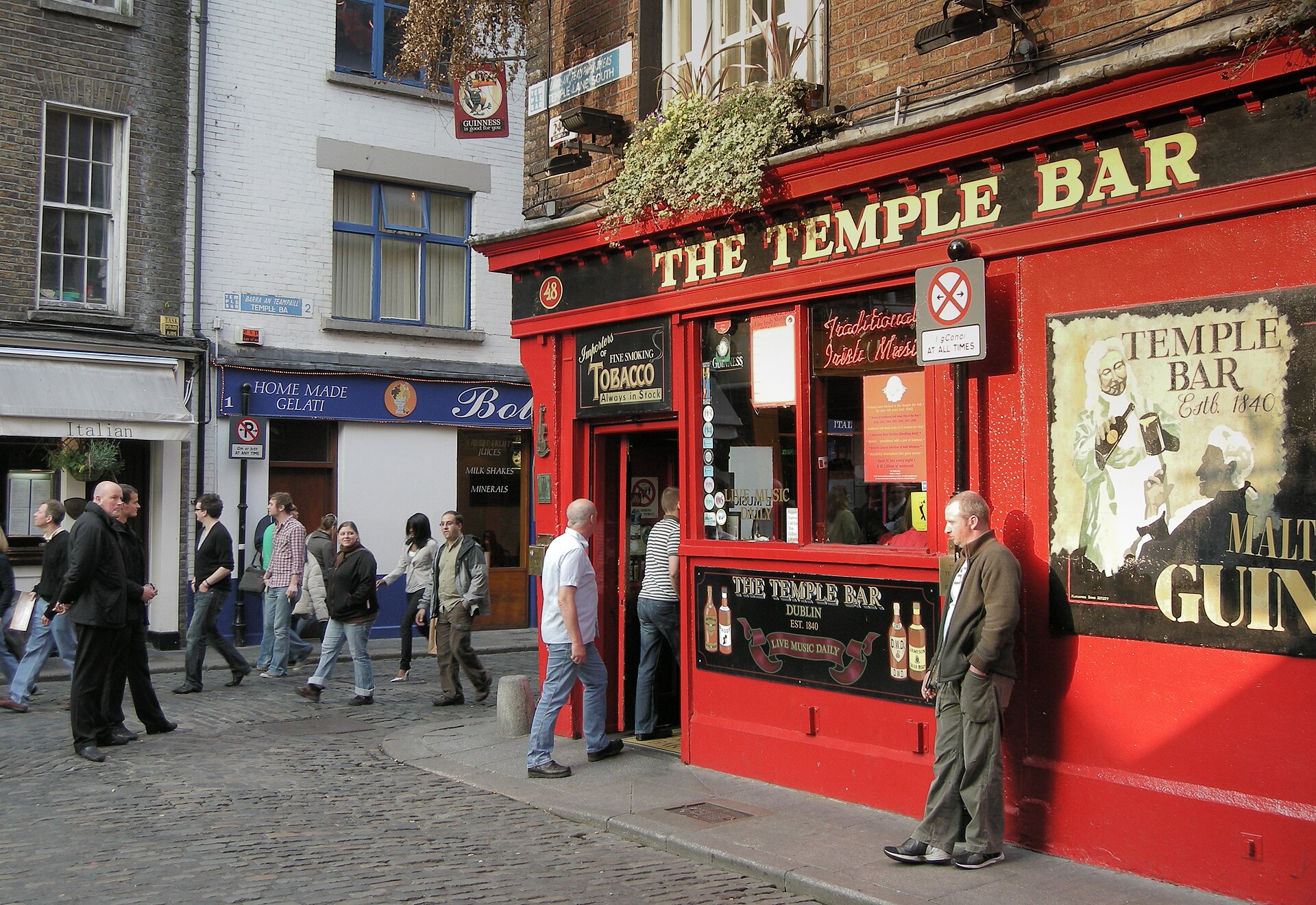

Temple Bar is Dublin’s most photographed and most misunderstood area. It’s the first place most visitors go and the first place most locals avoid.
So let’s clear something up straight away: Temple Bar is not a bar.
It’s a district. A cultural quarter. A carefully curated carnival. And depending on the day, it’s either oddly charming or a low-grade fever dream involving buskers and inflatable Guinness hats.
So what actually is Temple Bar?
It’s a small neighbourhood on the south bank of the Liffey, between Dame Street and the river: a few cobbled streets packed with pubs, buskers, restaurants, late-night takeaways, galleries, souvenir shops and more “Irish experience” than you probably asked for.
Yes, there’s a pub called The Temple Bar, and yes, it’s very red and very famous. But the district came first. The pub just named itself cleverly and leaned all the way into it.
Where does the name come from?
The area takes its name from the Temple family, who held land here in the 1600s; Sir William Temple, Provost of Trinity College, had his house and gardens here. A “bar” meant a riverside path or embankment, like London’s own Temple Bar. So “Temple Bar” is, more or less, the Temples’ bit of the riverbank.
Back then it was marshy and prone to flooding. It grew into a busy quarter of houses, workshops and traders, declined badly in the 20th century, was nearly flattened for a bus station, and was then reborn in the 1990s as Dublin’s “cultural quarter”. Translation: a pub every ten steps and street theatre from people in Viking hats.
The Temple Bar pub (yes, the red one)
You’ve seen the photo: bright red front, flower baskets, fairy lights. It’s lively, loud and full of people learning to say “sláinte”.
Is it iconic? Sure. Is it expensive? Very. Is it where locals drink? Only if they’re lost, or meeting someone from out of town.
If you want the experience, go in, take the photo, have one pint and leave before your card starts smoking. The Guinness is fine. The atmosphere is enthusiastic. Just know it’s closer to a theme park than a Dublin local.
Is Temple Bar worth visiting?
That depends what you’re after. If you want:
- Live music, mostly covers
- Neon shamrocks and souvenir shops
- Hen parties at 11am
- Bars that open early and close late
then Temple Bar will absolutely deliver. But if you’re hunting for:
- Quiet, old-school pubs
- A conversation with someone who isn’t on a pub crawl
- A cheaper pint
- Actual Dubliners
then keep walking. The real Dublin is a few streets away.
The better bits of Temple Bar
It’s not all plastic hats. Look out for:
- The Saturday food market in Meeting House Square.
- The Ha’penny Bridge at the river end. See the bridges of Dublin.
- Galleries and arts spaces tucked into the side streets, including the Temple Bar Gallery and Studios and the Irish Film Institute.
Where locals actually go (still nearby)
You don’t need a taxi. All of these are within a few minutes’ walk:
- The Long Hall, South Great George’s Street: Victorian pub, heavy mirrors, red snugs, unbothered by nonsense.
- Grogan’s, South William Street: pint, toastie, conversation. No music.
- The Stag’s Head, Dame Court: brass, mirrors, a good pint and a chance of actual quiet.
- The Lord Edward, Christchurch Place: an old pub on several floors, less noise, more character.
More in where to drink in Dublin if you hate tourist pubs.
Temple Bar survival tips (because you’ll probably go anyway)
- Don’t buy the plastic Guinness hat. Not even ironically.
- Eat first. It’s cheaper and better outside the district.
- Watch your phone and wallet. Pickpockets like crowds of distracted visitors.
- Go early if you want photos without the chaos.
- Leave when someone starts singing “Wonderwall”. That’s your cue. It’s always your cue.
- Don’t book a hotel in the middle of it unless you plan to be up at 2am anyway. See where to stay in Dublin.
A map in words: the streets of Temple Bar
- Temple Bar (the street) and Fleet Street: the main drag, with the red pub, the Auld Dubliner and the Oliver St John Gogarty. Loudest at night.
- Meeting House Square: a small square with a retractable canopy, the Saturday food market, outdoor film screenings in summer, and the Irish Film Institute and PhotoMuseum Ireland on its sides.
- Eustace Street: home to the Irish Film Institute, with an art-house cinema, a bar and a good café. The building was once a Quaker meeting house.
- East Essex Street: the Project Arts Centre, one of Ireland’s leading venues for new theatre and art, and the Smock Alley Theatre at the western end, in a restored 17th-century playhouse.
- Merchant’s Arch: the stone archway from the river into the district, opposite the Ha’penny Bridge, and the classic way in.
- Crown Alley and Cow’s Lane: independent shops, vintage clothes and the Gutter Bookshop. See shopping in Dublin.
Why a bus station nearly happened
In the 1970s and 1980s, the state transport company bought up much of Temple Bar to knock it down for a central bus station. While it waited, it rented the old buildings out cheaply, and artists, record shops, galleries and young businesses moved in. By the time the bus station plan was dropped, the area had become the city’s creative quarter. In 1991 the government set up a company to regenerate it, and the cobbles, squares and arts centres you see now came out of that. The pubs came out of everything else.
What a night in Temple Bar costs
A pint in the famous Temple Bar pubs costs noticeably more than it does a few streets away, sometimes several euro more, and food is often overpriced for what it is. Check the price board before you order, and eat outside the district. The music is free, which is the main thing you’re paying for.
Traditional music in and around Temple Bar
Most Temple Bar pubs have live music from the afternoon until late, much of it Irish folk and ballads for visitors. For more traditional sessions where locals play, try the pubs just outside the district, or head north across the river. Our guide to where to drink if you hate tourist pubs has the details, and hidden pubs has the quiet ones.
Staying in Temple Bar
It’s central and lively, and it’s noisy until the small hours, especially at weekends and on hen and stag nights. If you sleep lightly, stay a few streets away. Our guide to hotels in Temple Bar and around Trinity notes which are quieter.
For traditional Irish music away from the Temple Bar crowds, see our guide to the best trad music pubs in Dublin.
The verdict
Temple Bar isn’t where you find the soul of Dublin. It’s where you see how good Dublin has got at packaging that soul and selling it by the pint.
It’s chaotic, funny, overpriced, exhausting and, now and then, accidentally brilliant.
So go. But don’t stay. Take the photo, drink the pint, then walk two streets, find a snug in a quiet pub and let the real city happen. You’ll know you’ve found it when the barman doesn’t smile at you. That’s how Dublin shows affection.
For everything else worth your time, see our guide to things to do in Dublin.
Planning your trip? For better nights out than Temple Bar alone, see things to do in Dublin at night and trad music pubs.